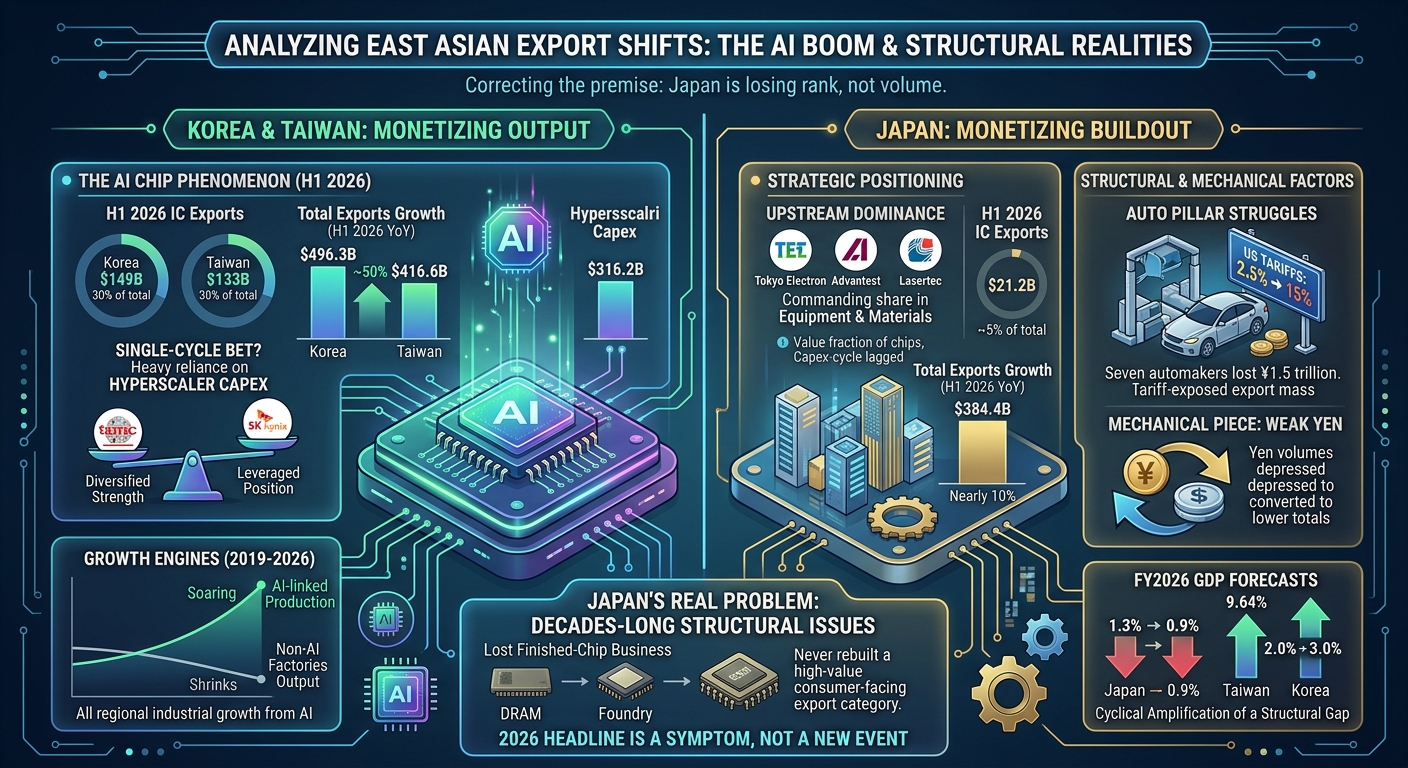
In the first half of 2026, South Korea and Taiwan each shipped more goods abroad than Japan did. It’s the first time either has done it, let alone both at once. Korea posted $496.3 billion, Taiwan $416.6 billion, Japan $384.4 billion.
The obvious reading is that Japan is in decline. That reading is wrong, or at least badly incomplete. Japan’s exports grew close to 10% year over year. It didn’t shrink. It got lapped.
One product line accounts for the gap
Korea’s integrated circuit exports came to $149 billion in the first half. Taiwan’s came to $133 billion. In both cases that’s roughly 30% of everything the country sold abroad. Korea’s six-month IC total was larger than its entire 2025 figure.
Japan’s integrated circuit exports over the same period: $21.2 billion. About 5% of the total.
Take AI chips out of the comparison and the three economies look far more alike than the headline suggests. TSMC, Samsung and SK Hynix sell the finished die, which is the single highest-value component in an AI server and the one buyers are currently willing to pay almost anything for. Japan doesn’t sell that.
Japan is upstream, where the revenue is smaller and later
The Japanese semiconductor position is real and it is strong. Tokyo Electron, Advantest and Lasertec hold dominant global share in the tools that make advanced chips, and Japanese firms supply a large share of the photoresists, gases and specialty materials that go into a modern fab. Semiconductor equipment has climbed from sixth to second in Japan’s top export categories in five years.
But two things limit how much that helps in a year like this one. The entire global wafer fab equipment market is a fraction of the value of the chips those tools produce. And equipment revenue is capex-lagged. It books when a fab gets built, not when HBM ships. Japan monetizes the buildout. Korea and Taiwan monetize the output. When demand spikes, output wins by a wide margin.
The other pillar went the wrong way at the same time
Autos have carried Japanese exports for four decades, and 2025 was the year that stopped working. US tariffs on Japanese vehicles jumped from 2.5% to 27.5% in April 2025, then settled at 15% in September under the bilateral framework. Japan’s seven major automakers lost roughly ¥1.5 trillion in the first half of 2025, the first simultaneous profit decline across all seven since the pandemic. Subaru, with the overwhelming majority of its sales in the US, absorbed ¥154.4 billion in tariff payments. Mazda posted its first net loss in five years.
Korea and Taiwan have nothing comparable in their export mix. Their growth engine was never in the crosshairs. Japan took a policy hit on its largest traditional category in exactly the window where it needed that category to hold the line.
There’s a mechanical factor too, and it’s worth naming because it inflates the story. The comparison is denominated in dollars. A weak yen depresses Japan’s dollar total even when yen-denominated volumes are rising, which they are.
What the winners should worry about
AI-related goods now make up over 40% of Korean exports, roughly double the share of two years ago. In Taiwan the figure is around 80%, up from about half before the pandemic. Meanwhile output at northeast Asian factories unrelated to AI has been shrinking outright. Every bit of the region’s industrial growth since 2019 has come from AI-linked production.
That is not a diversified industrial base pulling ahead. That is a concentrated bet paying off. Taiwan’s export economy is now close to a leveraged position on hyperscaler capital spending, and the growth forecasts reflect it. Taiwan’s statistics agency projects 9.64% GDP growth this year. Korea raised its forecast from 2.0% to 3.0%. Japan’s Cabinet Office cut its FY2026 projection from 1.3% to 0.9%.
Those numbers move together, in both directions. A normalization in AI orders would compress the gap fast, and it would hit Taiwan hardest because Taiwan has the least left over when chips are stripped out.
The structural problem underneath
None of this means Japan’s position is fine. The real issue isn’t the 2026 ranking. It’s that Japan lost the finished-chip business a long time ago, DRAM to Korea in the 1990s and leading-edge foundry to Taiwan after that, and never built a replacement high-value category facing end demand. It kept the picks and shovels and gave up the gold.
Defense and aerospace are starting to show up in the trade data following the security policy revision, and semiconductor equipment is genuinely strong. Neither is large enough to change the arithmetic yet.
This year’s headline is a cyclical amplification of a gap that’s been there for twenty years. The cycle will turn. The gap won’t.